
My parents and I left our home in East Berlin unceremoniously in the fall of 1960.
November 25, 1960, to be exact.
Much later in life that November 25th would pop up again. It is the day I immigrated to Belize. 49 years later. I had not planned for this coincidence; I actually was unaware of it until I translated my mother’s diary and saw the date we left East Berlin.
After transiting through various refuge facilities in West Germany, we ended up in a small town in the Black Forest. I grew up there happily enough, but Berlin was always in the back of my mind.
My grandmother, uncle, aunt, and cousin had remained in East Berlin. And through weekly letters my mother kept in touch with them.
As soon as I turned 18 and had a passport and my first paying job, I made my way to Berlin. West Berlin, to be exact.
I knew several people who had moved there. In the 1970s, West Berlin was a one-of-a-kind spot where locals didn’t have to deal with mandatory military service thanks to its special status. This made it a hotspot for young West Germans looking to get around the draft, turning the city into a hub for counterculture and alternative lifestyles.
The Berlin Wall, which cut off West Berlin from East Berlin and the rest of East Germany, gave the city a vibe all its own. It was like an island of freedom in the middle of communist territory, and that isolation fueled a thriving arts and music scene that became a big part of its identity.
West Berliners were technically citizens of West Germany, and they could vote in West German elections.
It was a weird, fascinating place to be. And it was my gateway into East Berlin. To go home.
The Wall had several crossings, sorted by who you were. West German, West Berliner, or foreigner. Only Checkpoint Charly had facilities for all three types of visitors to cross into East Berlin.
My crossing as a West German was at Heinrich Heine Strasse.
I don’t actually remember the first crossing. I just followed instructions on where to go, where to wait for what paperwork or stamp. I went empty-handed with a sanitized purse, with nothing in it or on me that could cause offense.
After crossing, I got on the S-Bahn to Gruenau.
It was 1971; there was no Google Maps, no Google Earth. For West Berlin there existed a giant folding paper map with flip-out folds. Which, of course, you could not take into East Berlin. You even had to watch that nothing you brought with you was wrapped in newspaper. It was best to pretend that there were no life forms, no existence, outside of the East.

I had been gone 11 years. But the minute I stepped off the S-Bahn – oh how I love the sound and smell of the S-Bahn – I remembered where to go.
A wooded lot on the left of the Wassersport Allee, turn left into Tegernsee, right into Kochelsee, and then left into Ammersee.
And already I could see our giant variegated maple tree towering over the fence at the end of the street.
As children my mother and my uncle climbed that tree, I climbed that tree, my cousins climbed that tree, and some of their children climbed that tree.
It is still there today, though much reduced after a necessary trim due to some old age rot.
So I rang the bell at the gate.
I, of course, recognized my uncle and aunt immediately, helped by the fact that I expected to see them. For them it took a moment to process who was at their gate.
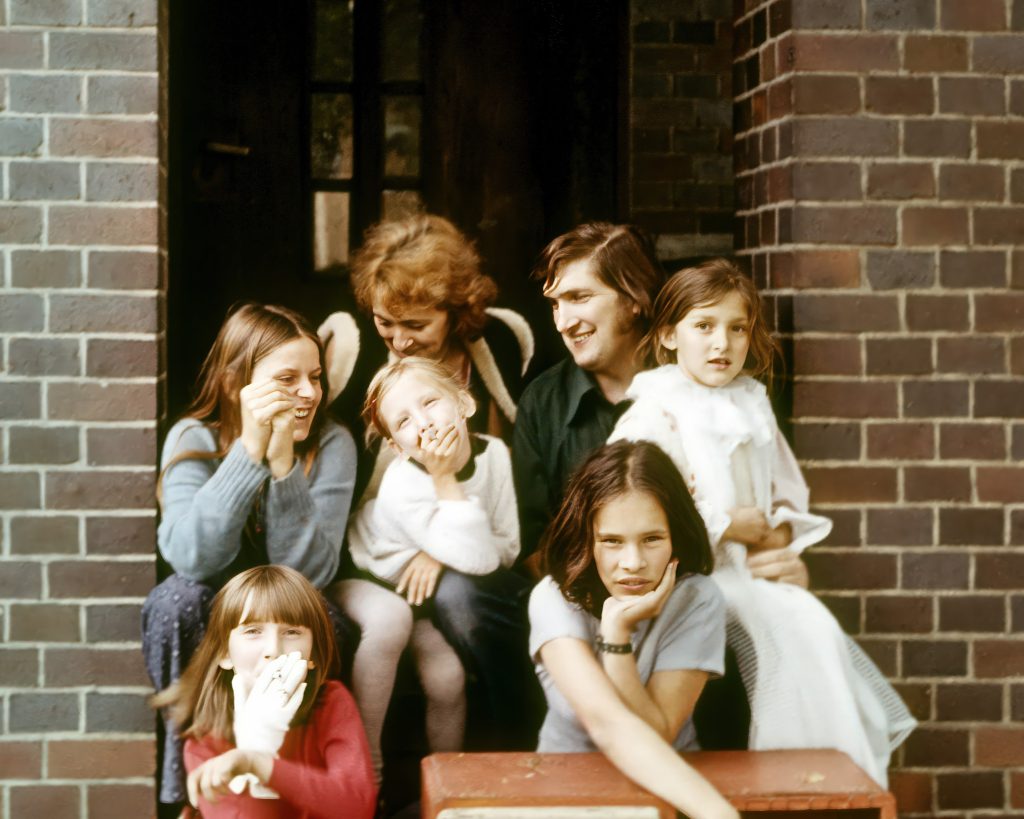
Four cousins – new to me – came out to greet me. All girls. Sofia,, Charlotte, Nadja and Rosa.
Dark, blonde, dark, blonde. Dark haired for my aunt. Blonde for my uncle.
And I don’t want to forget little Julia whom I never met. She died in infancy from a heart issue.
And so started my treks to East Berlin.
When I still lived in West Germany, I went every three months or so. Once I lived in West Berlin, my treks were monthly.
The routine was to be at Heinrich Heine crossing by 8am. The crossing took two hours. It took two hours whether there were 5 people or 50 people. Such is bureaucracy that wants to feel powerful.
And you had to be out by midnight.
You had to exchange 25 West Marks for East Marks. The exchange rate you got was 1:1. A huge joke since on the free market it was more like 10:1. Additionally, you were not allowed to take East German marks out. You were expected to spend them
One time I applied and got a permit to stay in East Berlin for a whole week. Not having to watch the clock every evening was such a pleasant relief.
My uncle and aunt served as my substitute parents.
We talked about life, politics, art, anything and everything.
If you ever watched M.A.S.H. where Margaret Houlihan talks about her husband and how his letters to her were all “ratatat” and his letters to his lover were all “wosh wosh”.
That was my parents vs. my uncle and aunt.
The wosh wosh was so needed to help me become a semi-sane adult.
Of course the monthly visits stopped when I left Germany. I revisited a few times from the USA .
Eventually my mother got up the courage to cross over too. When it was abundantly clear that nobody in East Germany was detaining you for having fled back in the days of the big exodus.
I have been back twice after the fall of the wall. I was completely disoriented. Imagine a walled city suddenly not having a wall, and instead just streets that go on like any normal street everywhere else. The last S-Bahn stop suddenly no longer is the last stop. The street I lived on for a while had our apartment block on one side of the street and the Wall on the other instead of houses…. I couldn’t even find my way.
And most of all – that shining city – West Berlin – was suddenly the crumbling part. East Berlin was sprouting brand-new buildings like mushrooms. All nice, new, and clean, not yet sooted and full of graffiti.
Air travel has never been my favorite transport, ear problems to boot, not to mention not being up for 24 hours of travel time with multiple flights anymore – there will be no more visits from my home here in Belize.